[Case 02]

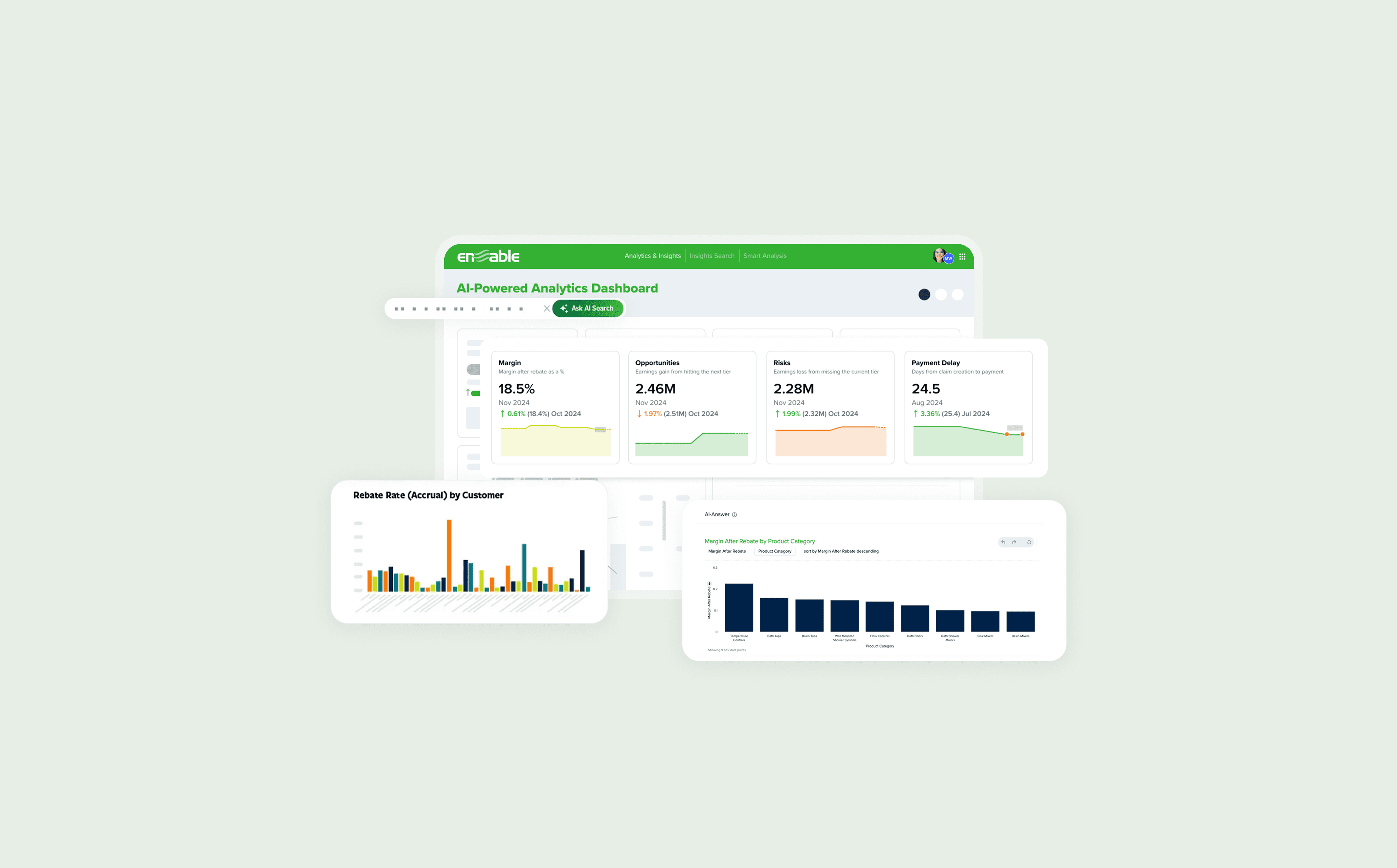
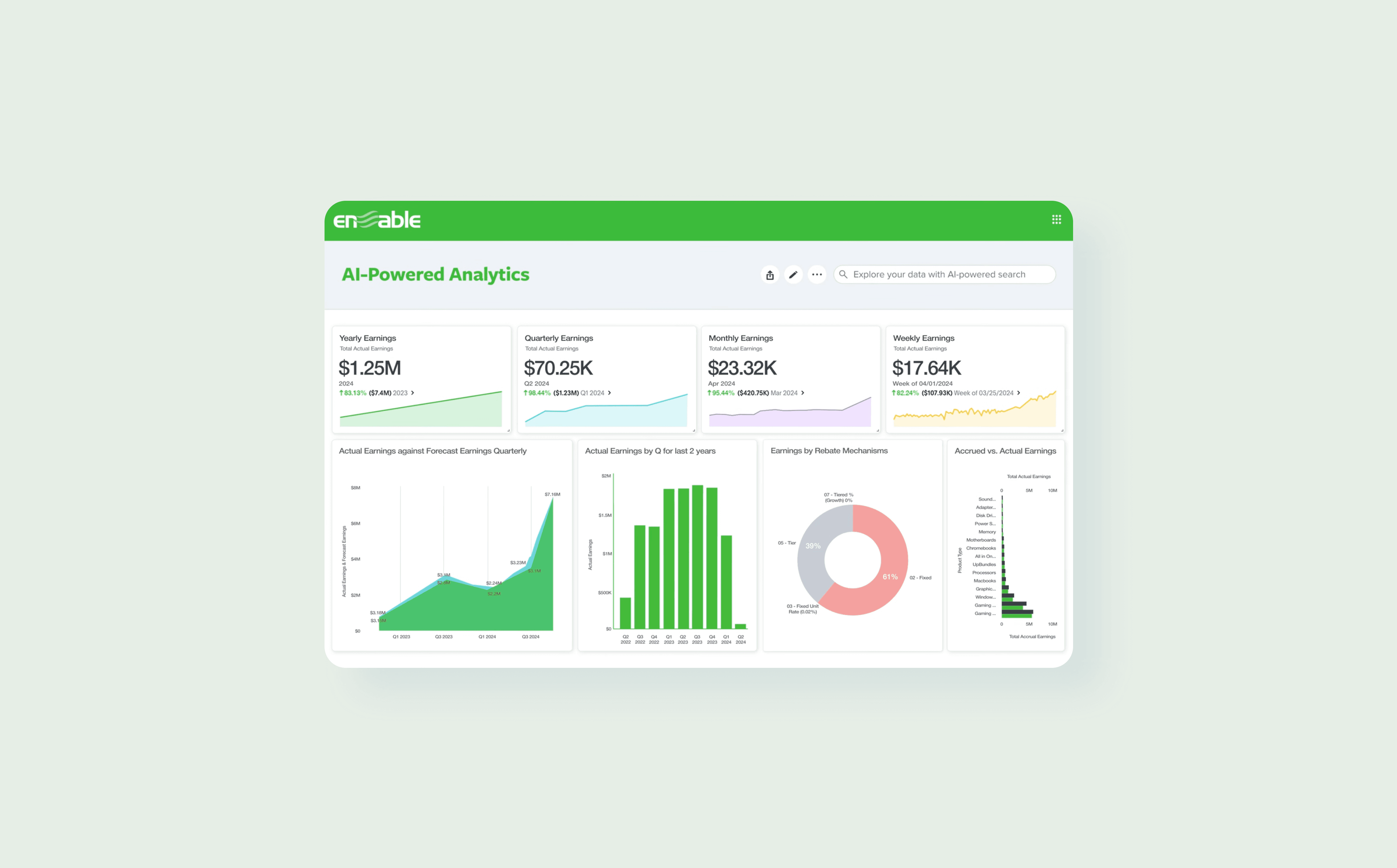
AI-Powered Analytics Dashboard

The SaaS Platform for B2B
Enable — Rebate Management Platform

Boosting Conversion Rates for E-commerce Checkout

[Project Overview]

Enable’s platform supports highly complex rebate workflows, negotiations, forecasting, and financial calculations, serving over 100,000 monthly active users. Despite its power, users struggled to transform large volumes of rebate data into actionable insights due to fragmented UX and high cognitive load.

[Problem Statement]

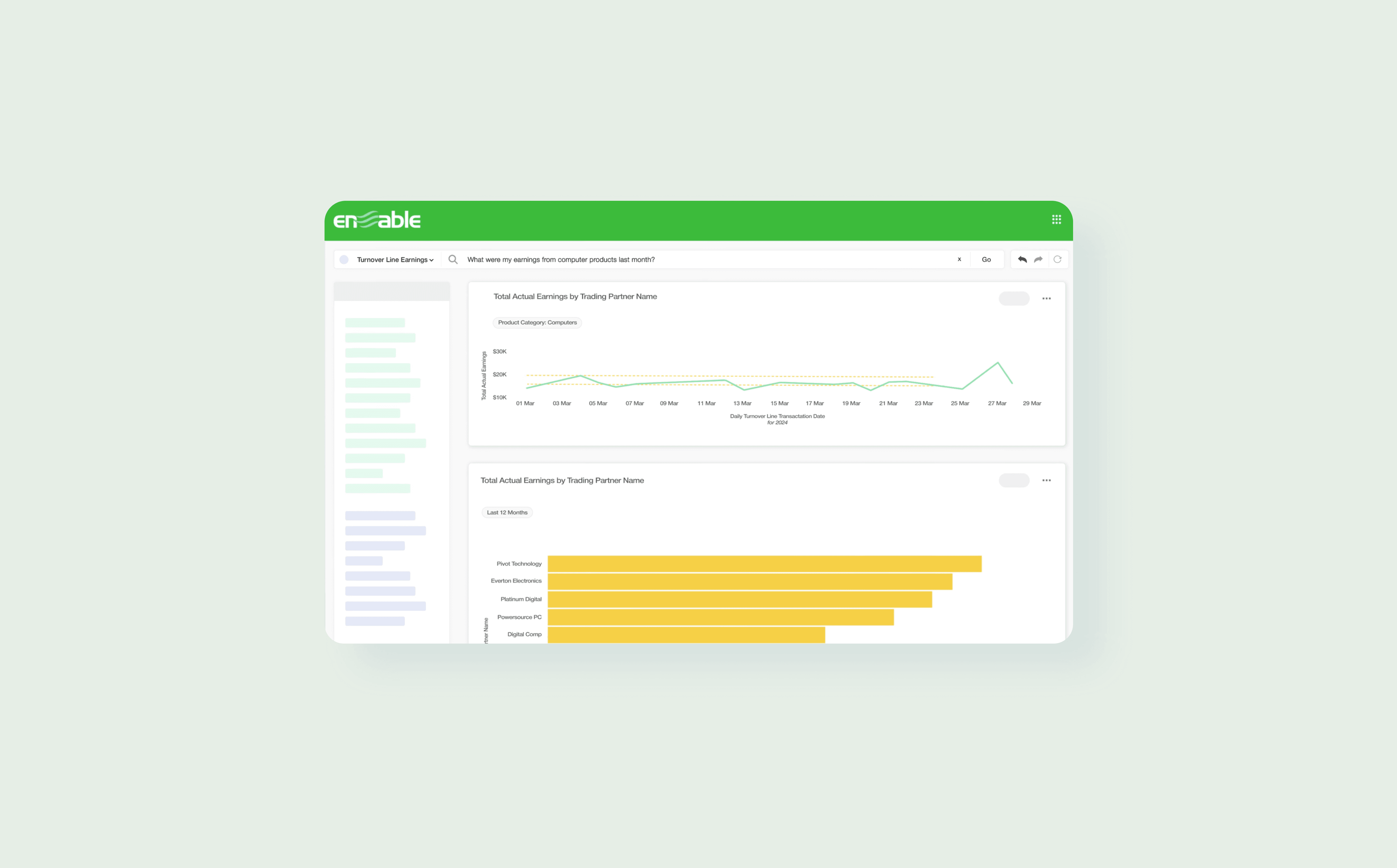
Rebate management generates massive amounts of complex data, but most teams lacked clear visibility and actionable insights. Traditional analytics required technical expertise or external tools, slowing decision-making and limiting access for sales and finance teams. The evolving product also suffered from inconsistent navigation and an ungoverned design system.

[Industry]

The SaaS Platform for B2B

[My Role]

Product Design

[Platforms]

Desktop
[Process]

[01] Research & Discovery

Analyzed user behavior using funnels, heatmaps, and session recordings.

Conducted interviews with sales, finance, and commercial teams.

Identified key friction points in data interpretation and decision-making.

[01] Research & Discovery

Analyzed user behavior using funnels, heatmaps, and session recordings.

Conducted interviews with sales, finance, and commercial teams.

Identified key friction points in data interpretation and decision-making.

[01] Research & Discovery

Analyzed user behavior using funnels, heatmaps, and session recordings.

Conducted interviews with sales, finance, and commercial teams.

Identified key friction points in data interpretation and decision-making.

[02] Insights

Users experienced cognitive overload due to dense data presentation.

Navigation patterns were inconsistent across modules.

Critical insights were hidden behind complex dashboards or required analyst support.

[02] Insights

Users experienced cognitive overload due to dense data presentation.

Navigation patterns were inconsistent across modules.

Critical insights were hidden behind complex dashboards or required analyst support.

[02] Insights

Users experienced cognitive overload due to dense data presentation.

Navigation patterns were inconsistent across modules.

Critical insights were hidden behind complex dashboards or required analyst support.

[03 Design Solution]

Reframed user journeys to reduce cognitive load and clarify next steps.

Redesigned information architecture to support faster decision-making.

Introduced clearer hierarchy, progressive disclosure, and contextual guidance.

[03 Design Solution]

Reframed user journeys to reduce cognitive load and clarify next steps.

Redesigned information architecture to support faster decision-making.

Introduced clearer hierarchy, progressive disclosure, and contextual guidance.

[03 Design Solution]

Reframed user journeys to reduce cognitive load and clarify next steps.

Redesigned information architecture to support faster decision-making.

Introduced clearer hierarchy, progressive disclosure, and contextual guidance.

[04] Design System Evolution

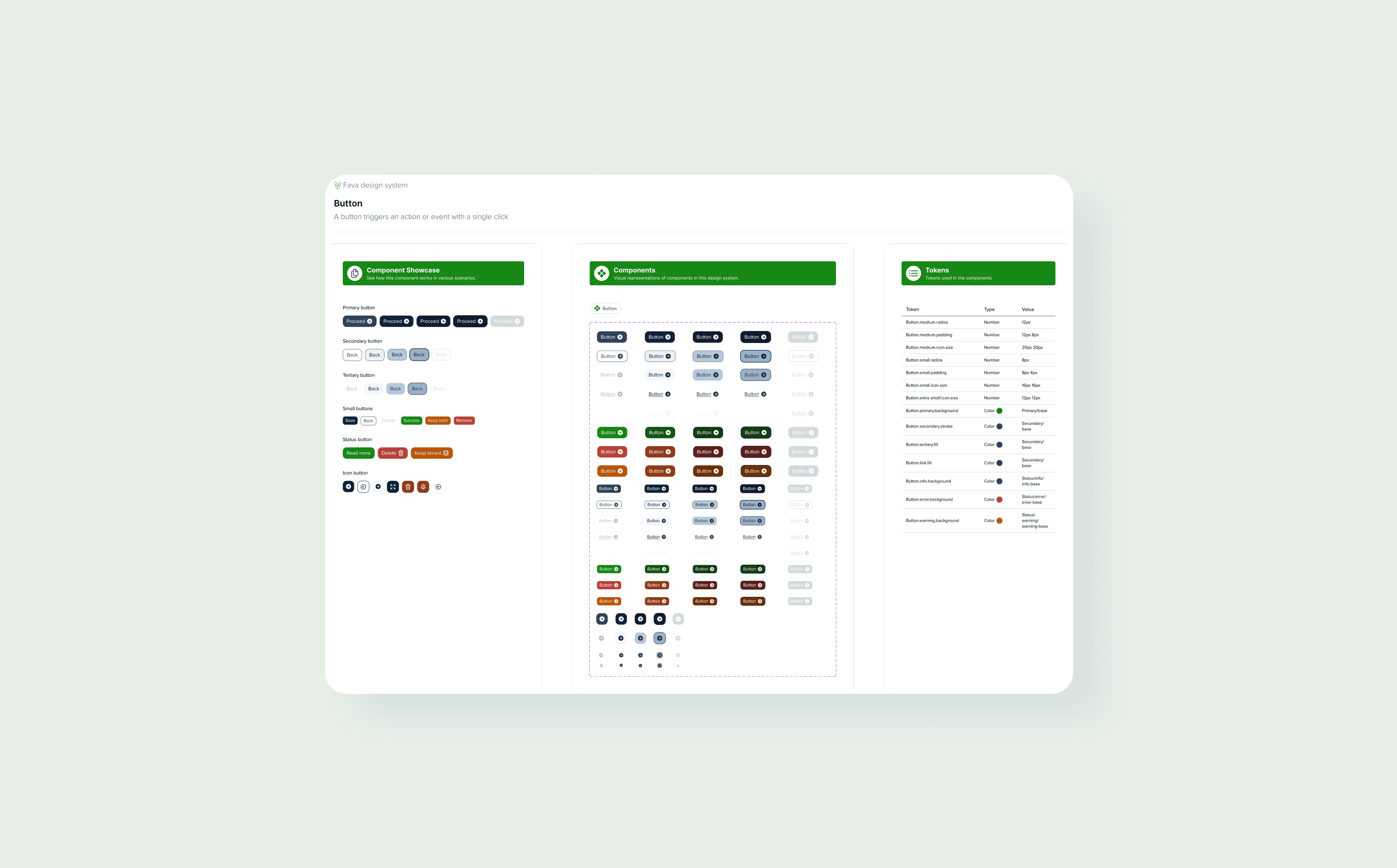
Created and scaled reusable UI components across modules.

Established consistency to support product scalability and faster development.

Reduced UX fragmentation across the platform by unifying interaction patterns, component behavior

[04] Design System Evolution

Created and scaled reusable UI components across modules.

Established consistency to support product scalability and faster development.

Reduced UX fragmentation across the platform by unifying interaction patterns, component behavior

[04] Design System Evolution

Created and scaled reusable UI components across modules.

Established consistency to support product scalability and faster development.

Reduced UX fragmentation across the platform by unifying interaction patterns, component behavior

[Outcome]

Improved clarity and predictability of complex rebate workflows, contributing to higher task completion and reduced user confusion.
Reduced onboarding and learning time for new users, while increasing engagement across analytics-heavy modules.
Supported scalable product growth through a unified design system, improving cross-team efficiency and consistency.

[Key Learnings]

AI-driven

interfaces unlock value for non-technical users.

AI-driven

interfaces unlock value for non-technical users.

AI-driven

interfaces unlock value for non-technical users.

Clarity

Clear information enables better decisions in data-heavy products.

Clarity

Clear information enables better decisions in data-heavy products.

Clarity

Clear information enables better decisions in data-heavy products.

Design system

Is critical for scaling enterprise products

Design system

Is critical for scaling enterprise products

Design system

Is critical for scaling enterprise products

Select this text to see the highlight effect