[Case 01]

Improving User Retention & Practice Engagement in a Yoga App

FLOGA — Product Redesign
Reducing Early User Drop-Off Through Onboarding Optimization

Improving user activation and practice completion in a mindfulness mobile app

[Project Overview]

Improving activation and guiding users to their first practice in a mindfulness mobile app

[Problem Statement]

Floga showed strong session-level engagement once users started a practice, with a ~98.5% completion rate among initiated sessions. However, significant drop-off occurred earlier in the funnel: 40.7% of users exited before reaching content discovery, and a further 48.6% dropped before the first interaction. GA4 funnel analysis revealed that onboarding and early navigation failed to guide users effectively to the first meaningful action, resulting in high abandonment before activation.

[Industry]

FLOGA — Product Redesign

[My Role]

Senior Product Designer

[Platforms]

iOS & Android
[Process]

[01] Research & Discovery

Reviewed GA4 funnel and behavioral data to understand where users dropped off before reaching the core product value.

Analyzed user behavior across key activation events to identify friction points in early navigation.

Direct user feedback and usage signals to support data-driven hypotheses around activation issues.

[01] Research & Discovery

Reviewed GA4 funnel and behavioral data to understand where users dropped off before reaching the core product value.

Analyzed user behavior across key activation events to identify friction points in early navigation.

Direct user feedback and usage signals to support data-driven hypotheses around activation issues.

[01] Research & Discovery

Reviewed GA4 funnel and behavioral data to understand where users dropped off before reaching the core product value.

Analyzed user behavior across key activation events to identify friction points in early navigation.

Direct user feedback and usage signals to support data-driven hypotheses around activation issues.

[02] Insights

40.7% of users dropped off before reaching content discovery (Deck). An additional 48.6% exited before interacting with the deck (swipe).

Users who started a practice showed ~98.5% completion, indicating a strong core experience.

The main UX issue existed before activation, not within the practice flow itself.

[02] Insights

40.7% of users dropped off before reaching content discovery (Deck). An additional 48.6% exited before interacting with the deck (swipe).

Users who started a practice showed ~98.5% completion, indicating a strong core experience.

The main UX issue existed before activation, not within the practice flow itself.

[02] Insights

40.7% of users dropped off before reaching content discovery (Deck). An additional 48.6% exited before interacting with the deck (swipe).

Users who started a practice showed ~98.5% completion, indicating a strong core experience.

The main UX issue existed before activation, not within the practice flow itself.

[03 Design Solution]

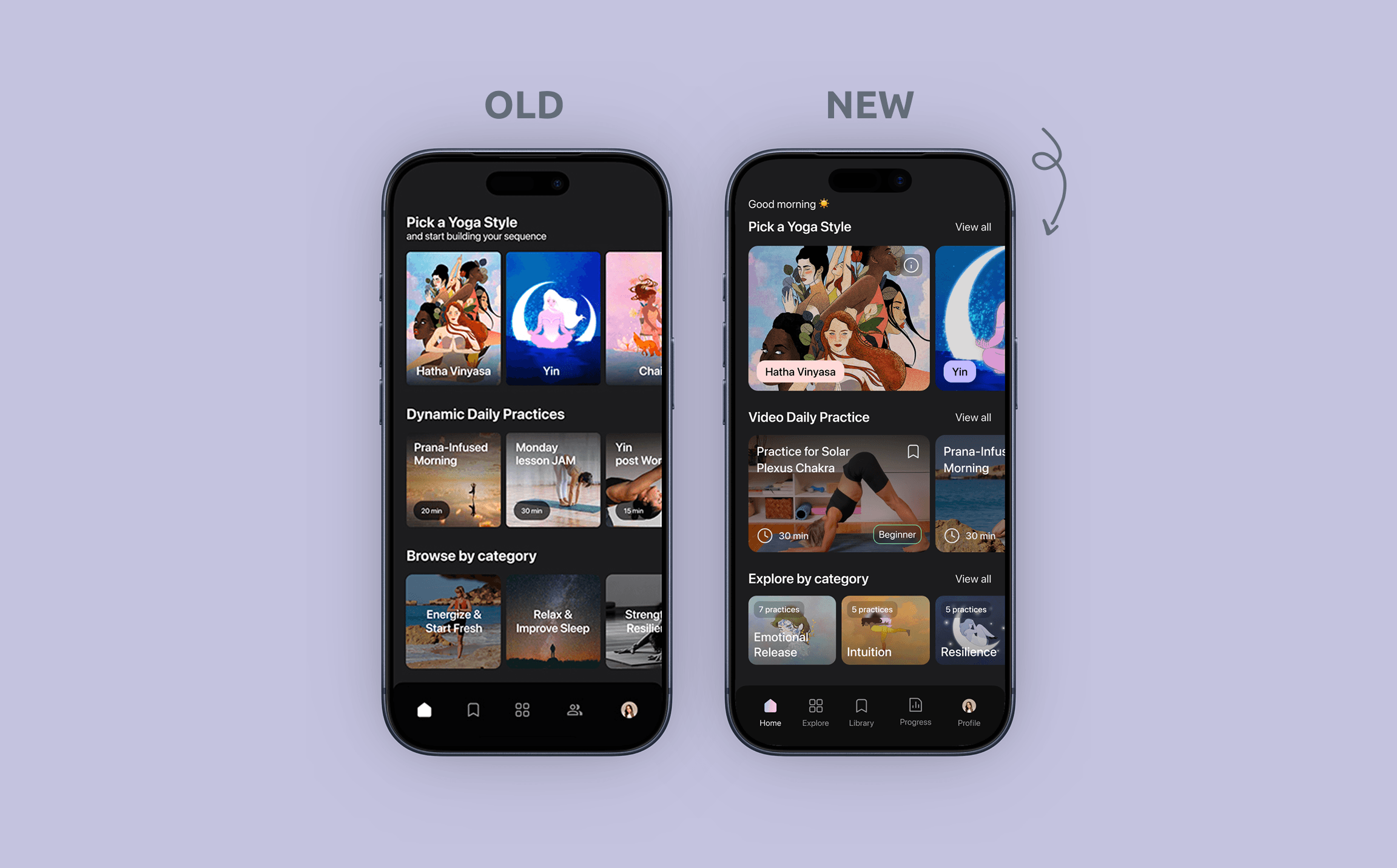
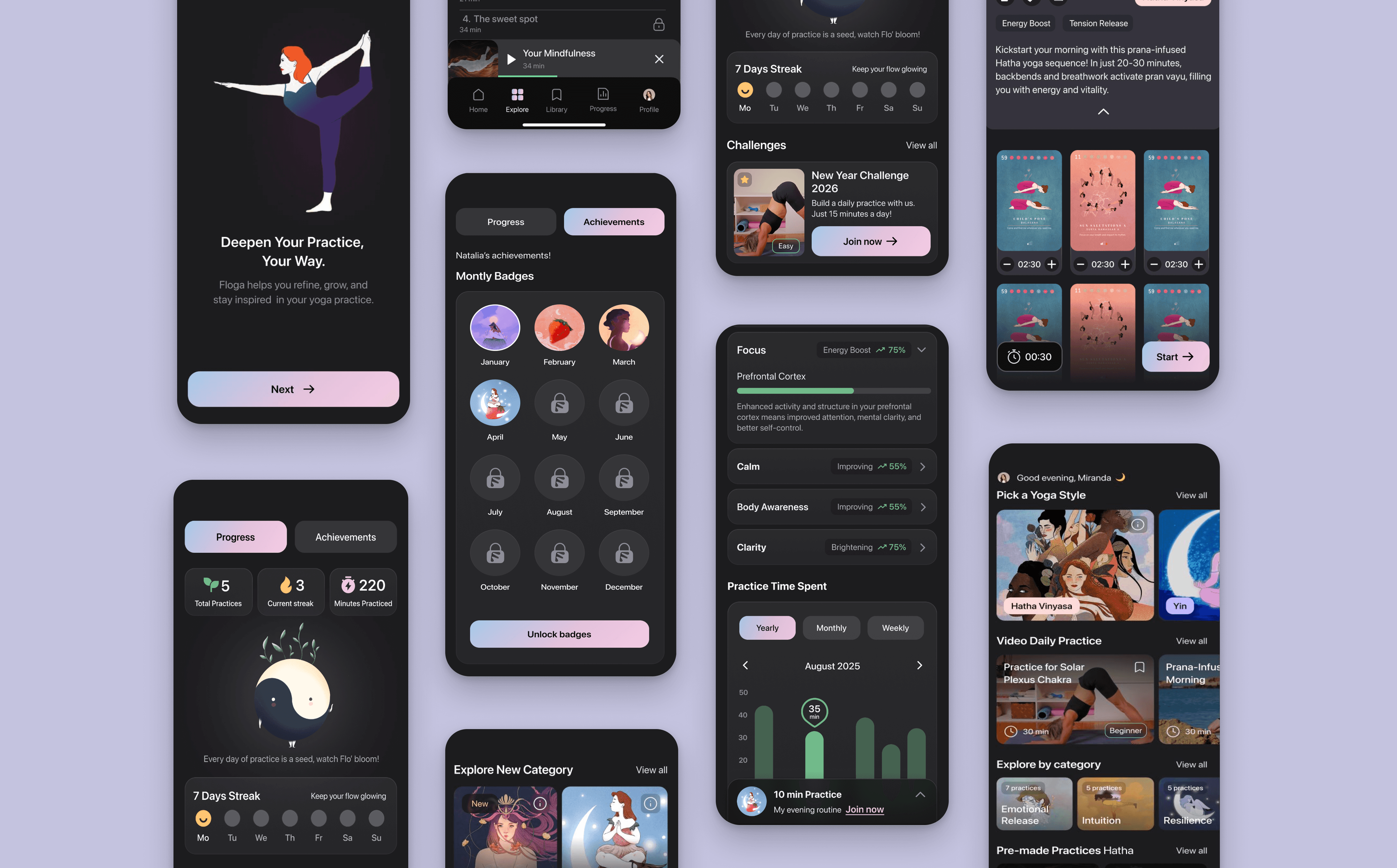
Clarified deck interaction by improving visual affordance and swipe guidance.

Simplified onboarding to reduce cognitive load and drive users directly to their first practice via a single primary CTA.

Aligned onboarding with the core flow: Deck → Swipe → Practice.

[03 Design Solution]

Clarified deck interaction by improving visual affordance and swipe guidance.

Simplified onboarding to reduce cognitive load and drive users directly to their first practice via a single primary CTA.

Aligned onboarding with the core flow: Deck → Swipe → Practice.

[03 Design Solution]

Clarified deck interaction by improving visual affordance and swipe guidance.

Simplified onboarding to reduce cognitive load and drive users directly to their first practice via a single primary CTA.

Aligned onboarding with the core flow: Deck → Swipe → Practice.

[04] Testing & Iteration

Reviewed direct user feedback to identify recurring friction points during onboarding and early navigation.

Used post-release funnel insights to inform further activation and flow iterations.

Monitored early-stage drop-off and practice completion to ensure changes did not negatively impact the core experience.

[04] Testing & Iteration

Reviewed direct user feedback to identify recurring friction points during onboarding and early navigation.

Used post-release funnel insights to inform further activation and flow iterations.

Monitored early-stage drop-off and practice completion to ensure changes did not negatively impact the core experience.

[04] Testing & Iteration

Reviewed direct user feedback to identify recurring friction points during onboarding and early navigation.

Used post-release funnel insights to inform further activation and flow iterations.

Monitored early-stage drop-off and practice completion to ensure changes did not negatively impact the core experience.

[Outcome]

98.5% practice completion rate among users who initiated a session
Clear identification of early funnel friction, with 40.7% drop-off before content discovery and 48.6% before first interaction
Improved activation clarity, ensuring more users reached the point where the product delivers its core value

[Key Learnings]

Activation matters

Once users started a practice, engagement was already very strong. The real challenge — and opportunity — was guiding users to that first meaningful action.

Activation matters

Once users started a practice, engagement was already very strong. The real challenge — and opportunity — was guiding users to that first meaningful action.

Activation matters

Once users started a practice, engagement was already very strong. The real challenge — and opportunity — was guiding users to that first meaningful action.

Clarity beats explanation

Reducing cognitive load and focusing onboarding on “what to do next” proved more effective than explaining features upfront.

Clarity beats explanation

Reducing cognitive load and focusing onboarding on “what to do next” proved more effective than explaining features upfront.

Clarity beats explanation

Reducing cognitive load and focusing onboarding on “what to do next” proved more effective than explaining features upfront.

Data reveals

GA4 funnel analysis clearly showed that UX issues existed before activation, allowing design efforts to focus where they had the highest product impact.

Data reveals

GA4 funnel analysis clearly showed that UX issues existed before activation, allowing design efforts to focus where they had the highest product impact.

Data reveals

GA4 funnel analysis clearly showed that UX issues existed before activation, allowing design efforts to focus where they had the highest product impact.

Select this text to see the highlight effect